Top 10 Romance Anime Where the Childhood Friend Actually Wins
If you have watched romance anime for any significant amount of time, you are deeply, painfully familiar with the “Childhood Friend Curse.” The setup is always the same: there is a girl or boy who has been by the protagonist’s side for a decade. They know their favorite foods, they wake them up for school, and they possess an unbreakable foundation of mutual trust. But the exact second a mysterious, wealthy transfer student with a bad attitude kicks open the classroom door, a decade of loyalty is instantly thrown in the trash. It is arguably the most exhausting, frustrating trope in the entire medium.
The tragedy of the childhood friend is that they are usually “too comfortable.” The protagonist takes their presence for granted, viewing them as a sibling rather than a romantic prospect. Breaking out of the “friend zone” requires shattering the safe, established status quo—a terrifying prospect that most anime avoid. But when a series actually commits to the childhood friend, the emotional payoff is astronomical. These relationships are not built on superficial crushes; they are built on years of shared history, deep vulnerability, and absolute, unwavering loyalty.
If you are completely sick of watching the day-one loyalist get sidelined for the sake of cheap drama, you have arrived at the perfect sanctuary. From chaotic tomboys to wartime mechanics, here are the Top 10 best romance anime where the childhood friend actually secures the ultimate victory.
Table of Contents
Amagami SS (Kaoru Tanamachi's Arc)
Kicking off our list is an anime that utilizes a brilliant narrative loophole to ensure the childhood friend gets a definitive, undisputed victory. Amagami SS uses an omnibus format—every four episodes, the timeline completely resets to focus on a different heroine, giving each girl her own conclusive, romantic ending. While every arc is highly entertaining, the storyline focusing on Kaoru Tanamachi is an absolute masterclass in executing the childhood friend dynamic to perfection.
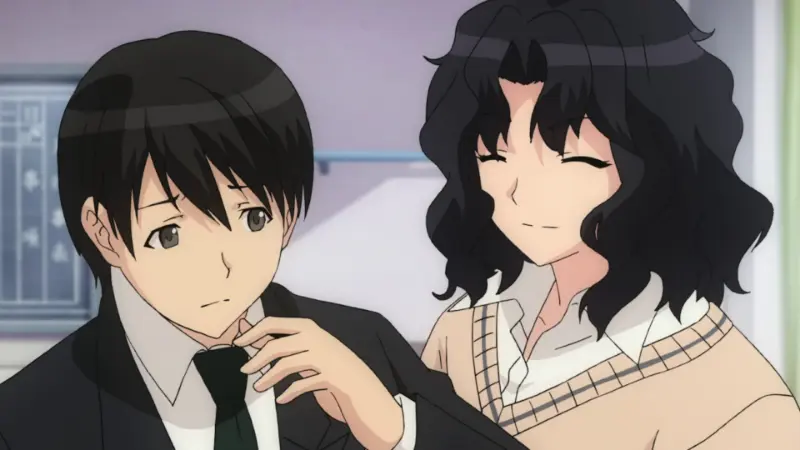
Kaoru and Junichi have an incredibly comfortable, deeply platonic relationship. They are the ultimate “bros.” They tease each other relentlessly, share junk food, and hang out without an ounce of romantic hesitation. The conflict in this arc is not about introducing a rival; it is entirely internal. It focuses on the agonizing, highly relatable awkwardness of realizing that your casual, rough-housing dynamic is suddenly laced with intense, undeniable physical attraction.
The arc beautifully captures the messy transition from friends to lovers. When Junichi and Kaoru cross the line—highlighted by a famously bizarre but deeply intimate scene involving a belly button kiss—the tension is palpable. They have to actively relearn how to treat each other. It is a highly satisfying, zero-drama narrative that perfectly illustrates why falling in love with someone who already knows all your flaws is the ultimate romantic victory.
Ai Yori Aoshi
Diving into the classic era of early 2000s anime, Ai Yori Aoshi presents a romance that is heavily suffocated by traditional Japanese societal pressures and deep familial trauma. Kaoru Hanabishi completely abandoned his wealthy, incredibly abusive corporate family, choosing to live a poor but peaceful life as a college student in Tokyo. Out of nowhere, Aoi Sakuraba—a beautiful, deeply traditional girl wearing a kimono—arrives at his apartment, declaring she has come to fulfill their childhood promise of marriage.
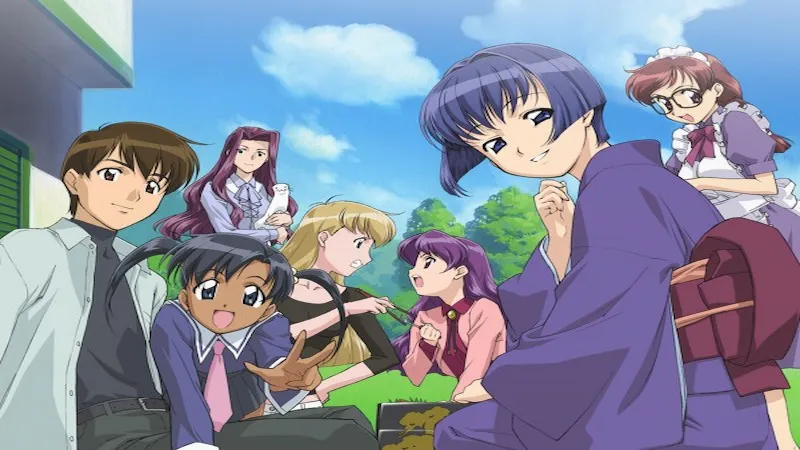
Aoi and Kaoru met as children, and while Kaoru’s memory of the event faded under the weight of his traumatic upbringing, Aoi anchored her entire existence to that promise. Her family, deeply entrenched in high-society politics, aggressively opposes the union because Kaoru is now a disgraced exile. Despite having a massive financial empire and her family’s wrath bearing down on her, Aoi’s loyalty to her childhood friend is absolute, unyielding, and completely breathtaking.
While the anime technically surrounds them with a harem of other girls who move into their boarding house, the romantic narrative is never actually in doubt. Aoi and Kaoru are deeply, profoundly in love from the very beginning. The series focuses entirely on how their shared childhood bond acts as a sanctuary, allowing them to heal from their respective familial traumas while building a quiet, loving domestic life together against all odds.
Ao Haru Ride
Ao Haru Ride (Blue Spring Ride) tackles the childhood friend trope with a heavy dose of psychological realism. Futaba Yoshioka had a sweet, innocent middle school crush on Kou Tanaka, a gentle and quiet boy. Before they could ever attend the summer festival together, Kou suddenly transferred schools without a word, leaving Futaba completely heartbroken. Years later, in high school, he suddenly returns under the name Kou Mabuchi—but he is completely unrecognizable.
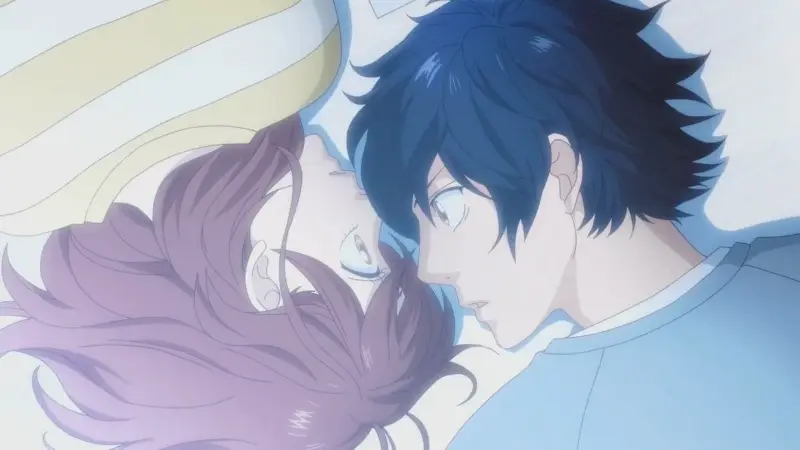
The boy who returned is cynical, cold, and deeply sarcastic. Futaba discovers that during his absence, Kou endured a devastating familial tragedy that completely shattered his personality. The brilliance of this anime is that Futaba cannot simply rely on their childhood nostalgia to win him over. She has to actively grieve the loss of the gentle boy she once knew, and make the conscious, difficult decision to fall in love with the broken, traumatized teenager standing in front of her.
The series is a masterful exploration of how time and trauma alter people. Futaba’s relentless determination to pull Kou out of his depressive isolation is not driven by a superficial crush; it is driven by her refusal to let the boy she loved sink into despair. It is a messy, deeply emotional Shoujo classic that proves reconnecting with a childhood friend is rarely a fairy tale—it is an active, profound choice to heal together.
Love Hina
You cannot discuss the history of anime romance without bowing to the absolute titan that is Love Hina. This series practically invented and popularized the modern harem genre, establishing tropes that are still heavily utilized today. Keitaro Urashima is a bumbling, academically struggling teenager who is violently determined to pass the entrance exams for Tokyo University. His entire motivation is anchored to a faded childhood promise he made to a girl fifteen years ago: if they both get into Todai, they will live happily ever after.
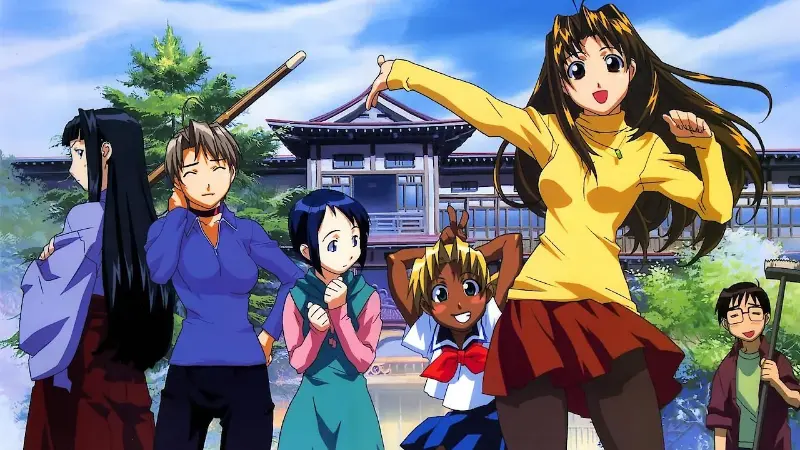
Through a chaotic twist of fate, Keitaro becomes the manager of the Hinata House, an all-girls dormitory filled with violent, eccentric tenants. Foremost among them is Naru Narusegawa, an academically brilliant, incredibly hostile tsundere who constantly beats Keitaro to a pulp for his accidental perversions. Despite the massive cast of potential love interests aggressively pursuing him, Keitaro remains stubbornly, blindly anchored to his childhood promise.
The beauty of Love Hina is the slow, highly comedic unraveling of that promise. As Keitaro and Naru study together, suffer academic failures, and endure endless misunderstandings, the narrative brilliantly reveals the true identity of the promise girl. While the physical comedy is wildly dated by modern standards, the underlying narrative—where a childhood promise serves as the unbreakable gravitational center of a massive harem—makes this a legendary victory for the childhood friend trope.
A Lull in the Sea (Nagi-Asu)
If you want a romance that weaponizes the childhood friend dynamic to deliver absolute emotional devastation, A Lull in the Sea is a breathtaking masterpiece. The story follows a tight-knit group of four childhood friends who live in a magical underwater village. When their school closes, they are forced to attend a school on the surface. Hikari is deeply, aggressively in love with his childhood friend Manaka, but his world is shattered when Manaka begins showing interest in a surface-dwelling boy named Tsumugu.
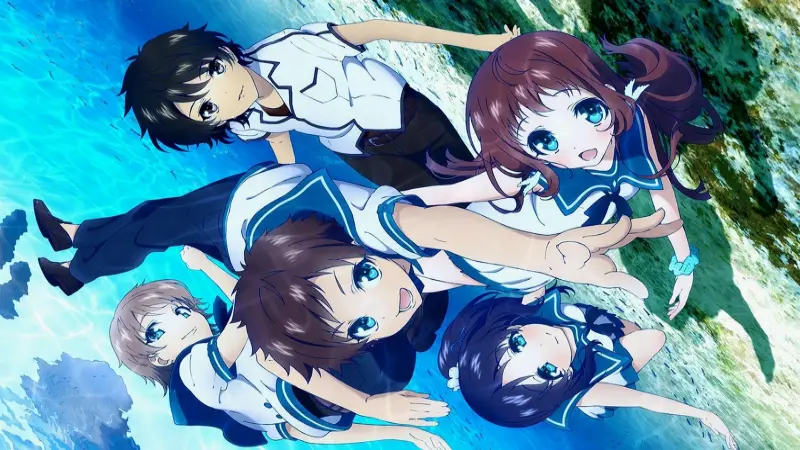
The anime perfectly captures the sheer panic of an established friend group breaking apart. Hikari’s jealousy is intense, but it stems from a profound fear of losing the girl who has been by his side his entire life. The narrative is heavily complicated by a complex web of unrequited crushes within their own group, further amplified by the deep-seated, systemic racism between the sea-dwellers and the humans on land.
However, the series pulls off one of the greatest narrative shifts in anime history with a mid-season time skip. A cataclysmic event forces the sea-dwellers into hibernation, but some awaken years later while the surface world has aged. Through the agonizing, beautiful chaos of time and changing dynamics, Hikari’s unwavering, absolute devotion to Manaka remains the unshakeable pillar of the show, resulting in a phenomenal, hard-earned victory for the day-one connection.
Cross Game
Disguised as a standard high school baseball anime, Cross Game is actually one of the most emotionally profound, slow-burn romances ever written. Ko Kitamura and Aoba Tsukishima have known each other since they were toddlers, and they absolutely despise one another. Their only common link is Wakaba, Aoba’s sweet older sister who happens to be Ko’s closest childhood friend and ultimate crush. When Wakaba tragically, unexpectedly dies in a summer camp accident in Episode 1, their world is completely shattered.
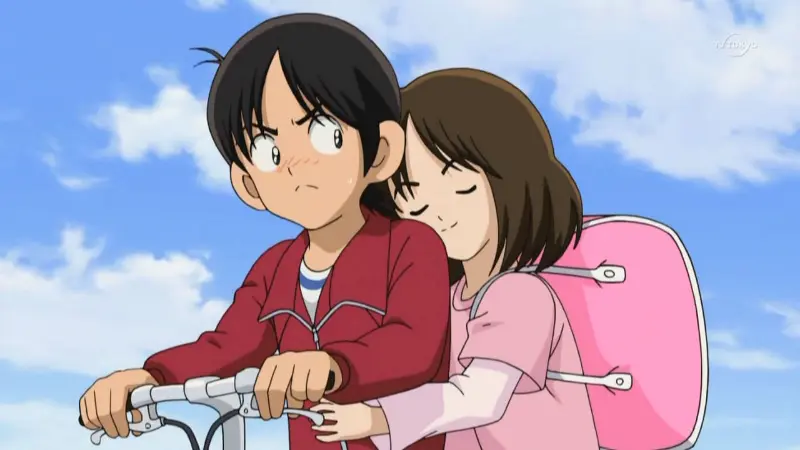
Following a massive time skip, Ko and Aoba are in high school, still bickering, still heavily antagonistic, but fundamentally chained together by their shared, unspoken grief. Aoba is a pitching prodigy who deeply resents Ko, while Ko secretly adopts Aoba’s rigorous training methods to fulfill Wakaba’s final dream of seeing him pitch at the legendary Koshien stadium. Their relationship is complex, messy, and deeply resentful.
The romance in Cross Game is a masterclass in subtlety. They do not have dramatic confessions in the rain; they communicate their evolving feelings entirely through the sport of baseball. As they slowly realize that they are the only two people on the planet who truly understand the depth of each other’s loss, their hostility melts into a fierce, unspoken reliance. It is a mature, heartbreaking, and ultimately triumphant exploration of a childhood bond surviving the ultimate tragedy.
High Score Girl
If you are looking for a romance that requires practically zero spoken dialogue to be deeply moving, High Score Girl is a phenomenal, nostalgic masterpiece. Set in the golden era of 1990s arcade culture, the story follows Haruo Yaguchi, an academically failing, deeply passionate gamer. He believes he is the undisputed king of his local arcade until he is absolutely humiliated in Street Fighter II by Akira Oono, the incredibly wealthy, perfectly composed, and completely silent elite girl from his class.
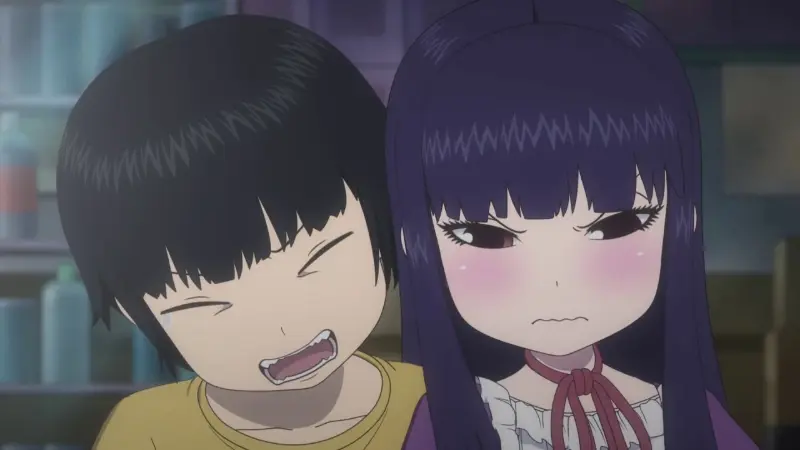
Akira’s life is a suffocating nightmare of extreme tutoring and strict societal expectations. The dirty, loud arcade is her only sanctuary, and Haruo is the only person who treats her like an actual human being—specifically, as a worthy rival. Their childhood bond is forged entirely through the physical language of arcade joysticks, quarter-mashing, and mutual competitive respect. They don’t need to talk; they understand each other’s souls through their gameplay mechanics.
As they grow up and the physical distances between them widen due to Akira’s family politics, Haruo’s dense, gamer-brained worldview slowly cracks. He realizes that Akira is not just his Player 2; she is the most important person in his life. Their desperate struggle to maintain their bond across years of separation, communicating their love solely through the medium of retro fighting games, makes this one of the most uniquely beautiful childhood romances in anime history.
Tamako Love Story
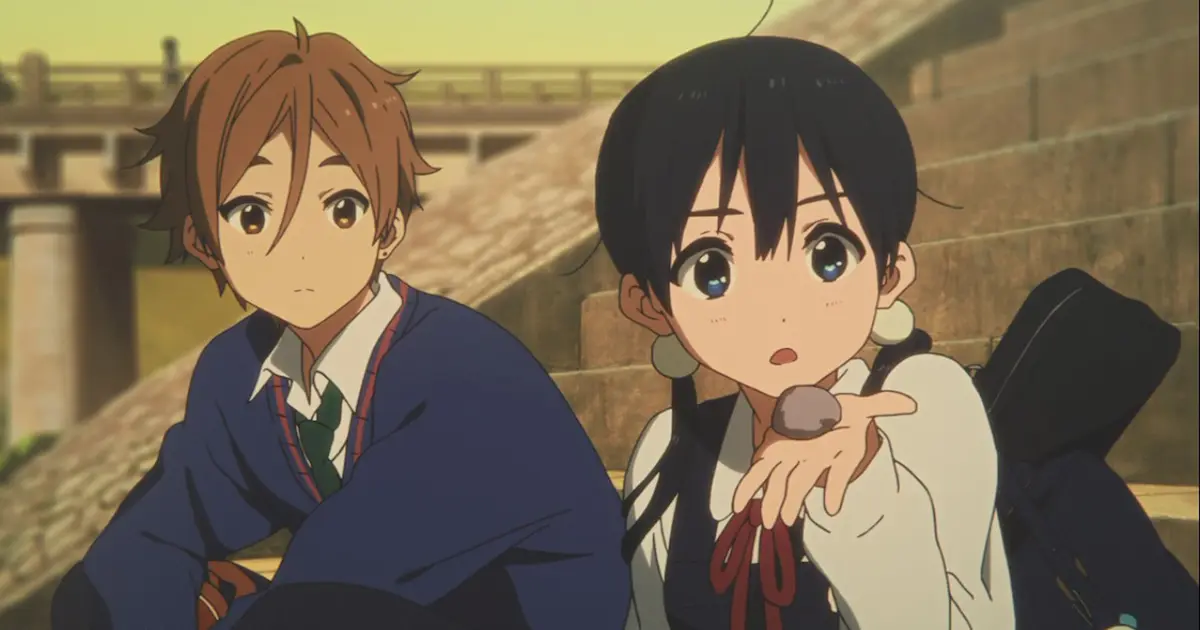
Serving as the breathtaking cinematic conclusion to the Tamako Market series, Tamako Love Story tackles the psychological terror of the childhood friend dynamic better than almost anything else in the medium. Mochizo and Tamako have lived across the street from each other their entire lives, their bedroom windows literally facing one another in the bustling Usagiyama Shopping District. Mochizo has been deeply in love with her for years, but Tamako is completely oblivious, perfectly content with their safe, unchanging friendship.
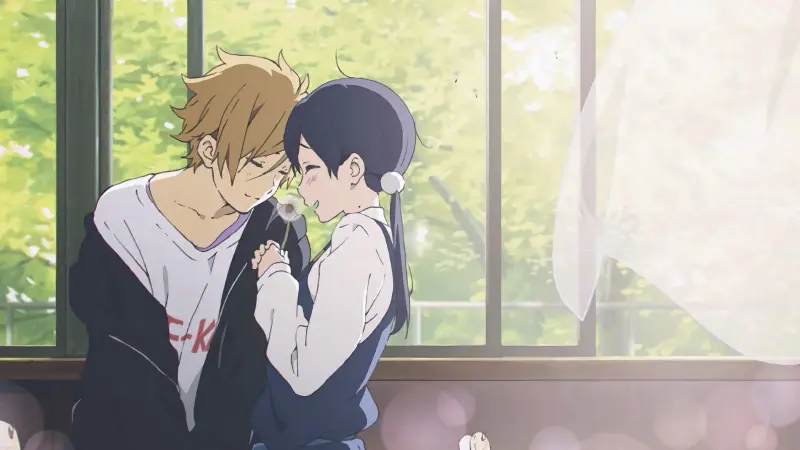
The conflict detonates when Mochizo, realizing he is moving to Tokyo for university, finally works up the courage to explicitly confess his feelings. The confession does not result in a romantic embrace; it triggers an absolute psychological meltdown in Tamako. She drops her belongings and runs away in pure panic. The movie brilliantly explores her profound grief—the terrifying realization that by accepting his romantic feelings, the simple, safe childhood dynamic they shared is permanently destroyed.
The beautiful animation by Kyoto Animation perfectly captures the agonizing weight of growing up. Tamako has to actively confront her fear of change, realizing that the shopping district she loves will inevitably evolve, and that clinging to the past will cost her the boy who matters most. It is an emotionally gripping, visually stunning masterpiece that perfectly encapsulates the terrifying leap of faith required for a childhood friend to win.
Fullmetal Alchemist: Brotherhood
While Fullmetal Alchemist: Brotherhood is universally hailed as one of the greatest dark fantasy, political action epics of all time, the core narrative engine that keeps the protagonist sane is an incredible childhood romance. Edward Elric and Winry Rockbell grew up together in the quiet countryside of Resembool. After Ed and his brother Alphonse suffer a horrific alchemical tragedy that destroys their bodies, Winry, a mechanical prodigy, steps up to build and maintain the metal automail limbs that allow Ed to fight.
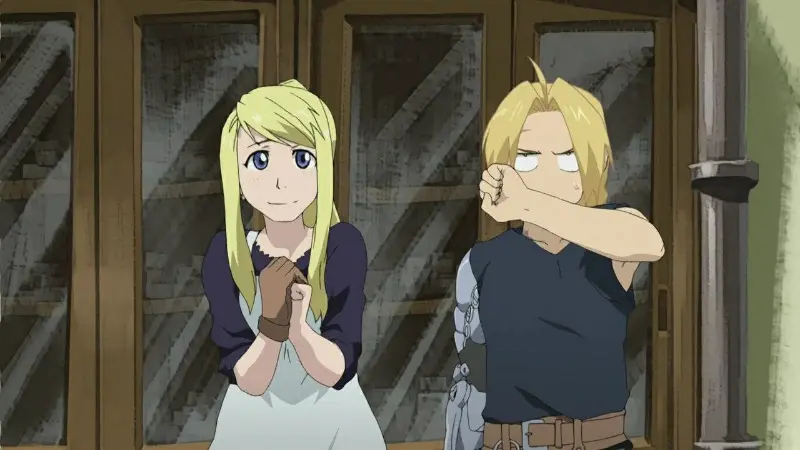
Winry is the ultimate execution of the supportive childhood friend trope. She is not a damsel in distress; she is Ed’s literal lifeline. Whenever his mechanical arm is shattered in brutal combat against homunculi, he must return to Winry to be fixed. She represents the warmth, humanity, and profound domestic peace that Ed is desperately fighting a bloody war to protect. She is his home, and her unwavering loyalty provides the emotional gravity for the entire 64-episode saga.
The climax of their relationship is legendary within the anime community. Instead of a flowery, generic confession, Ed utilizes the scientific principle of Equivalent Exchange to ask her out: “I’ll give you half of my life, if you give me half of yours!” Winry’s exasperated, joyful response cements them as one of the most perfectly written, deeply earned childhood friend romances ever put to screen.
Tomo-chan Is a Girl!
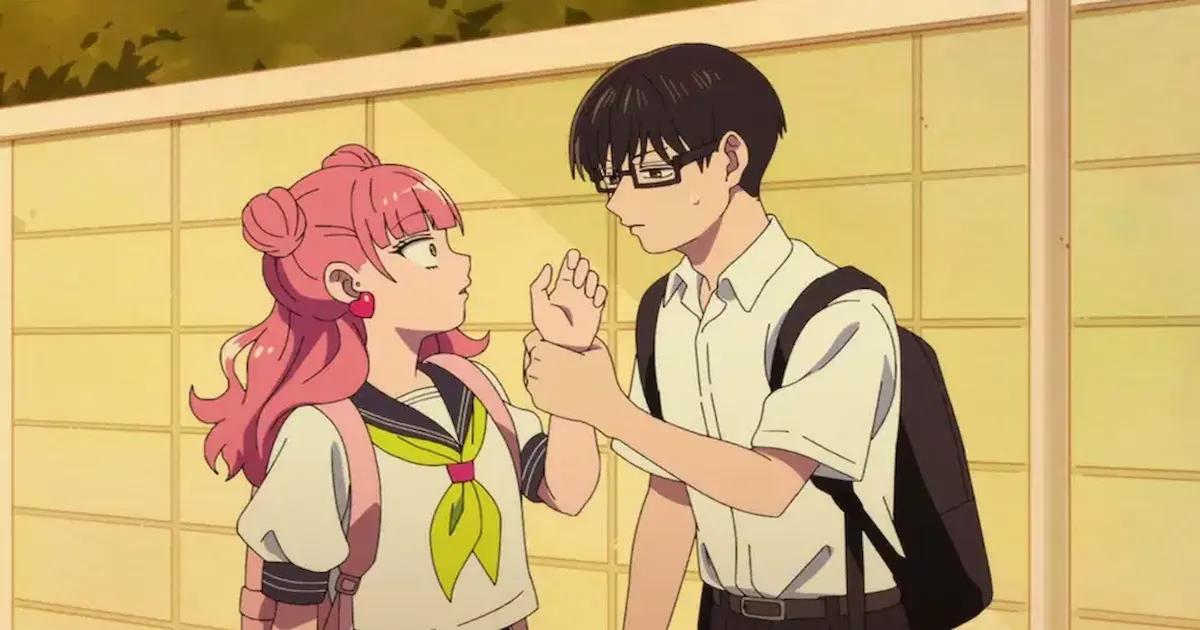
Sitting uncontested at the absolute peak of the trope is Tomo-chan Is a Girl!, an anime entirely dedicated to the grueling psychological warfare of the “friend zone.” Tomo Aizawa and Junichiro Kubota have been inseparable since they were toddlers. They play video games, train at the karate dojo, and regularly beat each other up. They are the ultimate “bros.” The massive problem is that Tomo is deeply, hopelessly in love with Jun, but Jun literally, fundamentally refuses to perceive her as a woman.
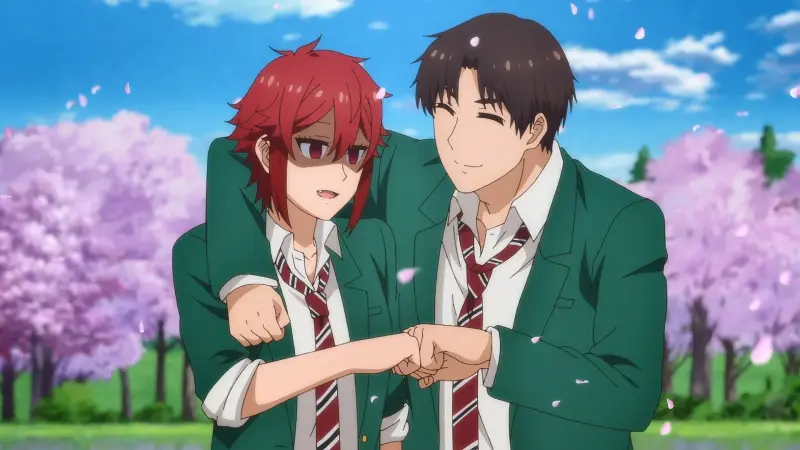
The comedy is incredibly sharp, relying on Tomo’s desperate, aggressive attempts to act “feminine” completely backfiring against her hyper-masculine instincts. However, beneath the physical gags lies a brilliant psychological narrative. As the series progresses, the audience realizes that Jun is not actually dense; he is subconsciously weaponizing his ignorance. Recognizing Tomo as a woman would force him to confront his own intense feelings for her, threatening to destroy the incredibly safe, unbroken friendship they have relied on their entire lives.
The climax of the series is a masterclass in breaking down those walls. Tomo refuses to let him hide behind his willful ignorance, explicitly demanding that he acknowledge her gender and her feelings. The transition from “best bros” to a deeply committed, highly protective romantic couple—without losing the rough-housing, competitive dynamic that made them friends in the first place—makes this the absolute greatest childhood friend victory in modern anime.
Breaking the Curse
The sheer satisfaction of watching a childhood friend win is that the relationship feels profoundly earned. These characters did not just meet at a bus stop; they have survived years of awkward phases, shared traumas, and the terrifying prospect of losing their best friend. Whether it is Winry repairing a broken metal arm or Tomo physically demanding to be seen, these narratives prove that shared history is the strongest foundation for a lasting romance. It is time we permanently bury the “transfer student” trope.
If you are craving a romance where the characters completely skip the high school politics and explore the intense dynamic of adult life, check out our list of the Top 10 Workplace Romance Anime for Adults. Or, if you want to vote on your favorite childhood friend victory, head over to our Smash or Pass hub and make your voice heard.
Which childhood friend had the most satisfying victory?
Frequently Asked Questions
What is the 'childhood friend curse' in anime?
Does the childhood friend win in Nisekoi?
Is Fullmetal Alchemist Brotherhood a romance anime?
Why is Tamako Love Story considered a masterpiece?
Does Kaoru win in Amagami SS?
Rank Your Favorites
Take a break and play our interactive Smash or Pass games. Vote on your favorite anime characters, game characters, and idols to shape the global tier lists.

Join the Discussion (0)