Top 10 Best High-Stakes Gambling Anime

The defining factor of a truly captivating psychological thriller is almost always cognitive dominance. It is not about who can punch the hardest; it is about who can manipulate the board, read their opponent’s micro-expressions, and weaponize human psychology to secure an absolute victory. The high-stakes gambling genre is the ultimate distillation of this concept. It places characters in situations where physical strength is completely irrelevant, and the only weapons available are cold logic, deception, and an ironclad tolerance for risk.
Unlike standard action shows, the tension in gambling anime stems entirely from the agonizing realization of consequence. The stakes are never just a few chips on a table. We are talking about crippling financial debt, the forced loss of human rights, or even the forfeiture of a human soul. As we have explored in our genius protagonists list and our breakdown of villain-centric narratives, these stories strip away the polite illusions of society to reveal the raw, grotesque greed hiding underneath. They force ordinary people into impossible corners, demanding they either outsmart the house or lose everything.
From the neon-soaked halls of elite academies to the smoke-filled basements of the criminal underworld, these shows deliver heart-pounding anxiety and unparalleled strategic warfare. If you are ready to push all your chips to the center of the table, here are the Top 10 best high-stakes gambling anime where the cost of losing is completely catastrophic.
Table of Contents
Legendary Gambler Tetsuya
Legendary Gambler Tetsuya grounds the gambling genre in a gritty, historically fascinating reality. Set in the immediate aftermath of World War II, Japan is depicted as a broken, starving nation completely devastated by defeat. With the economy in absolute ruins and basic necessities completely inaccessible to the common man, the only way to survive the harsh reality of the Shinjuku district is through the illicit, smoke-filled underground parlors. In this lawless environment, traditional morality is dead, and the protagonist, Tetsuya Asada, realizes that honest work will only lead to starvation.

To put food on the table, Tetsuya turns to high-stakes Mahjong. However, this is not a friendly parlor game; it is a brutal war of attrition where every player is actively trying to scam the others. The core philosophy of the anime is explicitly stated early on: cheating is not considered a sin. It is only a sin if you are caught. The series acts as an incredibly detailed masterclass in sleight of hand, misdirection, and the psychological fortitude required to pull off massive cons against hardened criminals who will not hesitate to break your hands.
The true brilliance of this classic series lies in how Tetsuya operates as a character. He is not a magical genius blessed with supernatural luck; he is a meticulous observer of human behavior. He wins by carefully analyzing the physical ticks, desperate tells, and massive egos of the older, veteran gamblers he faces. The gritty art style perfectly complements the heavy, suffocating atmosphere of the parlors, making every single tile draw feel like a life-or-death decision in a world that has already lost all hope.
C: The Money of Soul and Possibility Control
If you want a gambling anime that elevates the stakes from personal debt to the complete collapse of national economies, C: The Money of Soul and Possibility Control is a wildly ambitious, highly conceptual ride. The narrative centers on Kimimaro Yoga, an incredibly grounded economics student who just wants a normal, stable life. His reality shatters when he is approached by a bizarre, demonic bank clerk who offers him massive wealth in exchange for his “future”—essentially using his unlived potential as collateral to enter a surreal, alternate dimension known as the Financial District.

In this neon-lit, abstract arena, entrepreneurs known as “Entres” engage in high-speed, supernatural battles called “Deals.” They fight using Avatars known as “Assets”—powerful, demonic manifestations of their own personal futures. The battles are fought entirely with money; every attack costs capital, and taking damage physically drains your bank account. The gambling aspect here is heavily tied to macroeconomics, market crashes, and the horrifying realization that going bankrupt in the Financial District means your actual future in the real world is entirely erased.
The conceptual weight of the show is fantastic. When a high-level Entre loses a massive Deal, the resulting financial shockwave bleeds into the real world. Entire companies go bankrupt overnight, suicide rates skyrocket, and people’s children literally vanish from existence because their “possibility” was liquidated. Kimimaro is forced to gamble his own soul and morality not just to survive, but to prevent the hyper-capitalist monsters at the top of the food chain from completely cannibalizing the future of Japan for a quick profit.
Kakegurui Twin
Serving as an incredibly tight, focused prequel to the main series, Kakegurui Twin shifts the spotlight away from the chaotic insanity of Yumeko Jabami and focuses entirely on the brilliant, deeply ambitious Mary Saotome. Set one year before the events of the original anime, Mary arrives at the prestigious Hyakkaou Private Academy as a completely ordinary transfer student. She quickly discovers the school’s horrifying reality: academic scores mean absolutely nothing, and the entire social hierarchy is dictated strictly by high-stakes gambling.

Unlike Yumeko, who gambles purely for the sexual thrill of the risk, Mary gambles for survival and dominance. She starts with zero capital and no connections, forcing her to rely entirely on her raw intellect and ability to read through the elaborate cheating mechanics employed by the school’s elite. The stakes are immediately terrifying: students who fall into debt are stripped of their human rights, branded as “housepets,” and subjected to endless physical and psychological abuse by the rest of the student body.
This 6-episode mini-series perfectly captures the grueling, uphill battle of trying to dismantle a rigged system from the inside out. Mary teams up with her timid childhood friend, Tsuzura, and together they navigate a gauntlet of sadistic upperclassmen who use custom-built, heavily rigged casino games to enforce their rule. Watching Mary weaponize her arrogance and completely crush the egos of the wealthy elite through pure, unadulterated logic is incredibly satisfying and adds massive depth to her character in the mainline series.
No Game No Life
No Game No Life is what happens when you take the high-stakes gambling format and inject it with an overdose of hyper-vibrant fantasy aesthetics. The story follows Sora and Shiro, two agoraphobic, step-sibling NEETs who form the undefeated, legendary gaming duo known as “Blank.” They view the real world as a poorly designed, unbalanced garbage game. Their lives change forever when they are summoned by the God of Play, Tet, into Disboard—a magical realm where all forms of war, violence, and theft are strictly forbidden by ten absolute rules.

In Disboard, every single conflict, from minor border disputes to the fate of entire species, is settled through games. Blank is tasked with saving the weakest race on the board—Imanity (humanity)—which lacks any affinity for magic and has been pushed to the brink of extinction. The genius of the show is that Sora and Shiro are completely powerless in a traditional sense, but they possess a terrifyingly high IQ, eidetic memory, and an absolute mastery of probability and game theory.
The gambling sequences in this anime are massive, mind-bending spectacles. Whether they are betting the entire human race in a game of materialization Shiritori against literal angels, or playing a highly advanced, psychological game of chess against magical elves who are actively reading their minds, Blank always finds a way to win. The show flawlessly balances its colorful, comedic tone with genuinely brilliant strategic breakdowns, proving that human intellect is the most dangerous weapon on the board.
Death Parade
Stepping away from financial ruin and casino chips, Death Parade shifts the stakes to the ultimate, inescapable wager: the human soul. Produced by Studio Madhouse, the series takes place in Quindecim, a lavish, beautifully lit, and eerie cocktail bar located in the afterlife. When two people die at the exact same time, they arrive at the bar with their recent memories completely erased. They are greeted by Decim, a stoic, silver-haired bartender who acts as the arbiter of their eternal fate.
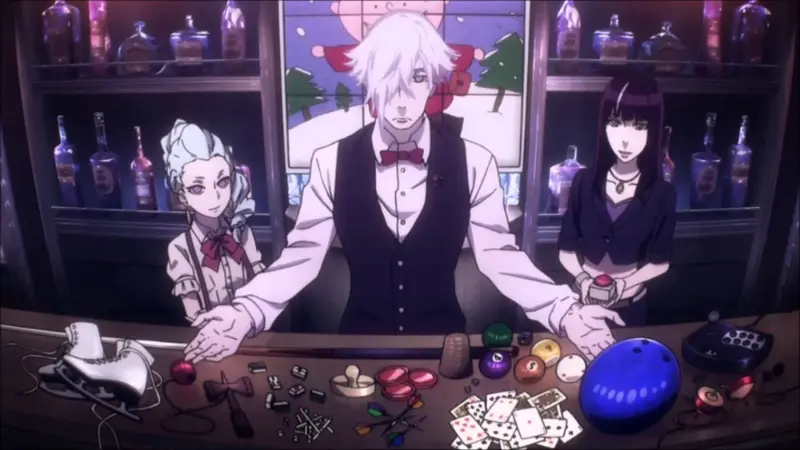
Decim forces the confused guests to participate in a randomly selected “Death Game”—ranging from billiards and darts to Twister or arcade fighting games. The trick is that the games are specifically rigged to inflict phantom physical pain and induce massive psychological stress. The purpose is not to see who wins the game, but to shatter the polite facade the guests wear. As the tension mounts, their memories slowly return, and the darkest, most desperate parts of their personalities are dragged into the light.
The gambling in Death Parade is purely emotional. The arbiters are betting on the capacity for human cruelty, observing whether a person will cheat, attack their opponent, or sacrifice their own humanity just to secure an artificial victory. The show is incredibly heavy, dealing with themes of suicide, infidelity, murder, and profound regret. It is a masterpiece of psychological profiling, wrapping devastating human tragedy inside the glamorous aesthetic of high-stakes parlor games.
One Outs
Do not let the baseball uniforms fool you; One Outs is an absolutely ruthless, high-stakes gambling thriller hiding inside a sports anime. The narrative completely ignores the power of friendship and teamwork, focusing instead on Toua Tokuchi, an arrogant, chain-smoking, underground gambling legend. After dominating a street-level betting game called “One Outs,” Toua is drafted into the professional leagues to save the Lycaons, the absolute worst team in the entire country.

The true tension of the series revolves around the “One Outs Contract” that Toua signs with the team’s greedy, corrupt owner. The terms are completely insane: for every single out Toua pitches, he earns five million yen. However, for every single run he gives up, he loses fifty million yen. The owner, wanting to bankrupt Toua, actively works to sabotage his own team from the shadows, creating a phenomenal multi-layered psychological war between the pitcher, the owner, and the opposing teams.
Toua is a masterclass in psychological manipulation. He only throws relatively slow fastballs, relying entirely on his terrifying ability to read the batters’ minds, feed their egos, and crush their spirits. He intentionally throws dangerous pitches, bends the rules of the stadium, and orchestrates massive mind games to force the opposition into making critical errors. It is a brilliant, zero-fluff dissection of risk management, where every single pitch carries the weight of massive financial ruin.
Akagi
Created by the legendary Nobuyuki Fukumoto, Akagi is a descent into the darkest, most terrifying corners of the Yakuza underground. The story begins in a smoke-filled parlor during a rainstorm, where a desperate man is losing his life savings to the mob in a game of Mahjong. Suddenly, a mysterious, silver-haired 13-year-old boy named Shigeru Akagi wanders into the parlor. Despite having never played the game before, Akagi takes over the seat, instantly reads the table, and completely dismantles the Yakuza professionals.

What makes Akagi an iconic protagonist is his complete, utter lack of fear. He is a borderline sociopath who does not care about money, status, or even his own life. He gambles purely because he is bored, chasing the elusive thrill of dancing on the absolute edge of death. His ability to maintain a deadpan, terrifyingly calm demeanor while taking massive, seemingly suicidal risks completely breaks the minds of the veteran criminals he plays against.
The anime reaches its legendary peak during the “Washizu Arc.” Akagi faces off against Iwao Washizu, a deranged, ultra-wealthy old man who forces young victims to play a specialized version of Mahjong using transparent tiles. The stakes are horrifying: Washizu bets his massive fortune, but Akagi must bet his literal blood, which is slowly drained from his arm using a machine every time he loses points. Watching Akagi casually taunt a billionaire while bordering on fatal blood loss is the pinnacle of anime gambling tension.
Liar Game
The anime community is currently shaking because Liar Game is finally receiving its long-overdue, masterpiece adaptation by Studio Madhouse this Spring 2026 season. The narrative kicks off when Nao Kanzaki, an agonizingly honest and naive college student, receives a mysterious black box containing 100 million yen (roughly one million dollars) and a VHS tape. She is informed that she has been drafted into the “Liar Game Tournament,” and she must protect the money from her opponent for 30 days. If she loses it, she assumes the massive debt.

Predictably, Nao is immediately conned out of the money by a trusted former teacher. Desperate and terrified of the life-ruining debt, she seeks the help of Shinichi Akiyama, a brilliant, freshly released master swindler who just took down a massive pyramid scheme. Together, they enter the subsequent rounds of the tournament, which scale up into massive, multi-player logic puzzles like the Minority Rule Game and the Contraband Game. The Madhouse adaptation is doing a flawless job capturing the oppressive, claustrophobic atmosphere of the manga.
What makes the currently airing Liar Game so incredibly intense is that there is absolutely zero physical violence or supernatural magic. The battles are fought entirely with high-level game theory, mathematics, and brutal psychological manipulation. Akiyama’s ability to read the hidden mechanics of a game, let the villains think they have won, and then completely crush their reality in the final hour is unmatched. It is a terrifyingly intelligent dissection of human greed and the inescapable trap of financial debt.
Kakegurui
Kakegurui is an absolute carnival of madness, bringing a highly stylized, cinematic flair to the gambling genre. The story takes place at Hyakkaou Private Academy, an elite institution for the children of Japan’s wealthiest politicians and business moguls. The school operates on a horrific, capitalist extreme: your academic standing means nothing, and everything is decided by gambling. The student council rules with an iron fist, taxing the students and turning those who fall into debt into literal slaves (“housepets”).

The delicate, corrupt balance of the school is completely shattered when Yumeko Jabami transfers in. On the surface, she is a polite, wealthy, and beautiful student. But beneath the facade, she is a compulsive gambling addict who derives literal, euphoric pleasure from the threat of losing everything. She does not care about winning money or climbing the social ladder; she just wants to experience the raw adrenaline of a coin flip where her life is on the line. She is an agent of pure, unadulterated chaos.
The animation studio, MAPPA, went absolutely wild with this series. The anime is famous for its grotesque, hyper-detailed facial expressions that warp the characters’ faces into demonic smiles and sweaty, panic-stricken grimaces when the stakes get high. Yumeko actively seeks out the most rigged, dangerous games operated by the student council, purposefully exposing their cheating methods just so she can raise the stakes to suicidal levels. It is a fast-paced, highly eroticized, and incredibly addictive psychological thriller.
Kaiji: Ultimate Survivor
Standing alone at the absolute summit of the gambling genre is Kaiji: Ultimate Survivor. Nobuyuki Fukumoto’s magnum opus is a masterpiece of tension, despair, and human resilience. Unlike the cool, collected geniuses on the rest of this list, Kaiji Ito is a completely pathetic, unemployed loser who spends his days stealing hubcaps and drinking cheap beer. His life spirals out of control when a debt collector informs him that he is responsible for a massive loan he co-signed for a former coworker.
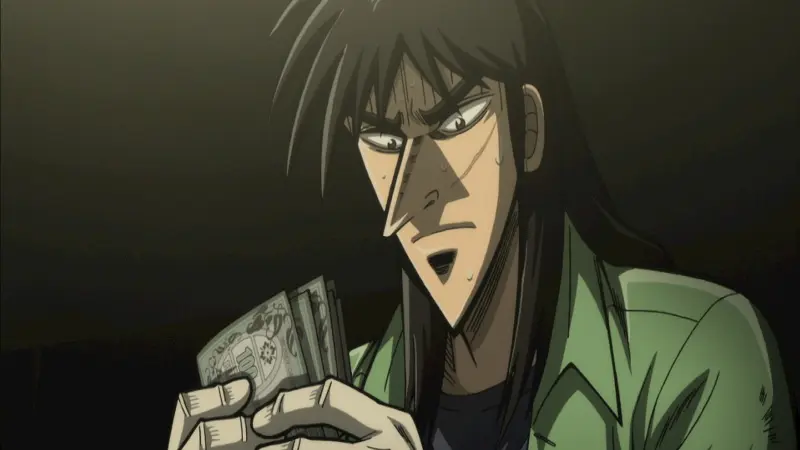
To clear his debt, Kaiji is invited aboard a luxury cruise ship called the Espoir to participate in a massive, underground gambling tournament. The games start deceptively simple—like Restricted Rock-Paper-Scissors—but quickly evolve into psychological torture chambers. Kaiji is constantly betrayed by people he thought were his friends, forced into massive, unpayable debt, and pushed to the absolute brink of suicide. But it is in these moments of utter, inescapable despair that Kaiji’s dormant genius finally awakens.
The tension in this anime is suffocating. You genuinely feel the physical toll of the risks being taken. In one iconic arc, Kaiji is forced to walk across a narrow, electrified steel beam suspended between two massive skyscrapers just to erase his debt, while wealthy billionaires drink wine and bet on whether he will fall to a gruesome death. Later, he bets his own eardrum and fingers in rigged card games. Kaiji is not a superhero; he cries, he panics, and he breaks down, which makes his eventual, desperate triumphs the most satisfying moments in anime history.
The House Always Wins (Usually)
The sheer adrenaline rush of a high-stakes gambling anime is completely unmatched in the medium. Whether you are watching Shinichi Akiyama dismantle a rigged system with pure mathematics in the new 2026 Liar Game adaptation, or holding your breath as Kaiji bets his literal fingers on a single card draw, these shows prove that the most intense battles are fought in the mind. They leave us questioning our own morality and wondering exactly how far we would go if our backs were against the wall.
If you need a break from the massive financial anxiety, but still want to see characters push past their limits, be sure to dive deeper into our Tropes Hub. You can cleanse your palate with some lighter fare, like the best zero-to-hero anime, where the grind is about self-improvement rather than destroying your opponent’s bank account.
Finally, do you think you have the strategic mindset to survive the Hyakkaou Academy or the Espoir? Head over to the Smash or Pass global arcade right now. Cast your votes on the most cunning gamblers in anime history and see if your risk tolerance matches up with the rest of the community.
Which protagonist would you trust with your life savings?
Frequently Asked Questions
Why is gambling such a popular theme in psychological anime?
Is the Liar Game anime finally out?
What is the difference between Kaiji and Akagi?
Do you need to know how to play Mahjong to watch Akagi or Tetsuya?
Why is One Outs considered a gambling anime instead of just a sports anime?
Rank Your Favorites
Take a break and play our interactive Smash or Pass games. Vote on your favorite anime characters, game characters, and idols to shape the global tier lists.



Join the Discussion (0)