Top 10 Best Detective Anime to Watch

The anatomy of a perfect mystery relies entirely on the respect it shows its audience. A true detective narrative does not insult your intelligence with sudden, magical plot contrivances or “deus ex machina” revelations in the final five minutes. It operates as a meticulous, high-stakes game of psychological chess between the author and the viewer. The clues are always scattered right in front of you—hidden in the background of a photograph, buried in the specific phrasing of an alibi, or masked by the seemingly random behavior of a suspect. The thrill comes from the agonizing tension of waiting for the investigator’s mind to finally connect the bloody, disparate threads before the killer strikes again.
Let us address the elephant in the room immediately: Detective Conan is the undisputed king of the genre. However, committing to a 1,000-episode behemoth is a daunting task that filters out the vast majority of modern viewers. If you have been exploring our Dark Anime Hub or analyzing the hyper-intelligent mind games over in our genius protagonists list, you know we prioritize tightly wound, highly concentrated thrillers. We are looking for narratives that strip away the episodic filler and plunge directly into the suffocating abyss of serial killer manhunts, political conspiracies, and forensic breakdowns.
From utilizing historical botany to unravel imperial assassinations, to diving directly into the fractured subconscious minds of active serial killers, the investigative genre offers a flavor of tension completely unmatched by standard action shows. Grab your notepad and lock the doors—here are the Top 10 best detective anime that will keep you guessing until the absolute final frame.
Table of Contents
Link Click
While technically a donghua (Chinese animation), Link Click has firmly embedded itself as an absolute powerhouse in the global mystery community. The premise revolves around a small photography studio run by two young men, Cheng Xiaoshi and Lu Guang, who possess a highly specific, rule-bound supernatural ability. By high-fiving, Cheng can literally dive into the exact moment a photograph was taken, possessing the body of the photographer for precisely 12 hours, while Lu guides his actions telepathically from the present to ensure the timeline remains perfectly intact.

What begins as a series of episodic, deeply emotional corporate espionage and missing persons cases rapidly spirals into a massive, interconnected serial killer manhunt. The detective work in this series is phenomenal because the protagonists are actively navigating crime scenes in the past while racing against the clock. The tension is suffocating; Cheng is heavily empathetic and constantly tempted to alter tragic events, while Lu serves as the cold, calculating anchor demanding strict adherence to the rules of causality to prevent catastrophic butterfly effects.
The pacing and directing of Link Click are genuinely masterful. The series is infamous for executing some of the most jaw-dropping, stressful cliffhanger endings in the medium, accompanied by a brilliantly timed electronic ED track that drops right as the plot twists. It takes the classic “armchair detective” trope and weaponizes it, forcing the investigators to physically experience the terror of the victims they are trying to save.
Ron Kamonohashi's Forbidden Deductions
Ron Kamonohashi’s Forbidden Deductions takes the traditional “Sherlock Holmes” eccentric genius archetype and injects it with a deeply disturbing psychological flaw. Ron Kamonohashi was widely considered the absolute brightest, most flawless student to ever attend BLUE, an elite international detective training academy. However, he was unceremoniously expelled and permanently banned from ever working a case due to a terrifying, subconscious psychological condition: whenever Ron corners a culprit and completely shatters their alibi, his sheer deductive pressure inadvertently hypnotizes them into committing suicide on the spot.
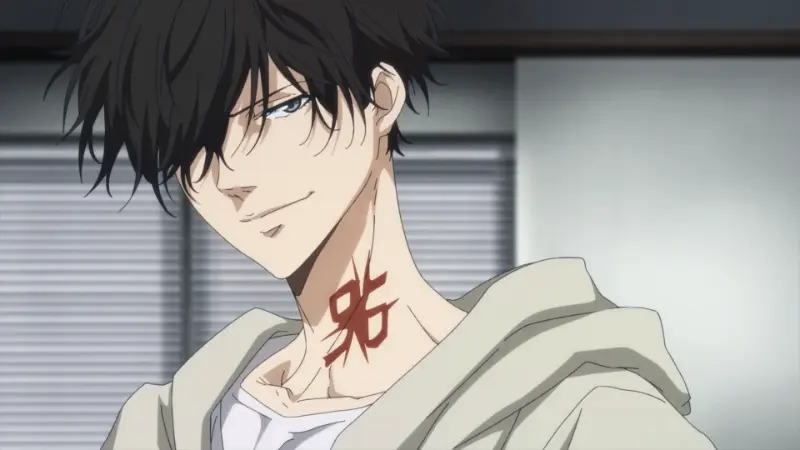
To bypass this lethal flaw, Ron forms an illegal partnership with Totomaru Isshiki, an incredibly earnest but highly incompetent police investigator. Ron does all the brilliant, lightning-fast deductive legwork from the shadows, physically feeding the answers to Totomaru, who then publicly solves the case and physically restrains the culprits before Ron’s ‘suicide command’ can take effect. It is a brilliant, highly entertaining dynamic that adds massive stakes to the end of every investigation.
The mysteries presented in the series are heavily reminiscent of classic, locked-room ‘whodunits’ popularized by Agatha Christie. Ron’s ability to notice microscopic inconsistencies—the specific wear on a shoe, the angle of a blood splatter, or the precise timing of a train—is deeply satisfying to watch. The overarching narrative slowly introduces a massive, global syndicate attempting to weaponize Ron’s lineage, escalating the series from episodic murder mysteries into a highly serialized thriller.
Undead Murder Farce
If you want a detective narrative dripping with gothic atmosphere and highly stylized violence, Undead Murder Farce is an absolute hidden gem. The premise is entirely unique: Aya Rindou is an immortal detective whose body was stolen by a mysterious villain. Now existing purely as a severed, highly intelligent head carried around in a golden birdcage, she travels 19th-century Europe alongside her muscle, Tsugaru Shinuchi—a half-demon fighter who relies on her deductive brilliance to survive his own curse.

The genius of this series is how it treats supernatural entities. Instead of relying on magical nonsense, Aya applies rigorous, Sherlock-level deductive reasoning and forensics to creatures like vampires, werewolves, and phantoms. When a vampire is murdered in a locked room, Aya mathematically calculates the exact bite radius, the specific blood coagulation times of immortals, and the structural integrity of the gothic architecture to completely corner the killer. It is a brilliant fusion of fantasy and cold, hard logic.
The world-building is heavily enriched by the inclusion of iconic literary figures from the era. The protagonists frequently clash with, or work alongside, characters like Sherlock Holmes, Arsène Lupin, and the Phantom of the Opera. The dialogue is razor-sharp, filled with incredibly fast-paced, highly theatrical banter between the severed head and her half-demon bodyguard, making the exposition drops just as entertaining as the brutal combat sequences.
Moriarty the Patriot
To truly understand the brilliance of a detective, you must first understand the mind of the criminal they are hunting. Moriarty the Patriot flips the traditional mystery script, placing the audience directly behind the eyes of William James Moriarty, the legendary nemesis of Sherlock Holmes. Set in late 19th-century Britain, the society is completely paralyzed by a rigid, tyrannical class system where wealthy nobles can torture and murder commoners with absolute impunity.

William, operating as a highly charismatic mathematics professor, secretly acts as a “Crime Consultant.” When a commoner is wronged by the untouchable elite, William engineers the perfect, untraceable murder, allowing the victim to exact their revenge while slowly destabilizing the British Empire from the shadows. The deductive thrill of this anime comes from watching William construct flawless, multi-layered alibis and locked-room scenarios that completely baffle Scotland Yard.
The dynamic completely shifts into high gear when Sherlock Holmes enters the narrative. Instead of viewing Sherlock as a threat, William actively utilizes him as an unpredictable variable in his grand design. The intellectual cat-and-mouse game between the two absolute geniuses—one trying to construct the perfect crime to change society, and the other desperately trying to unravel the threads to find the truth—delivers some of the highest psychological tension in the entire genre.
Erased
Erased is a masterclass in utilizing supernatural mechanics to amplify the raw, grounded tension of a murder mystery. Satoru Fujinuma is an unfulfilled, cynical manga artist who possesses an involuntary ability called “Revival,” which sends him back in time a few minutes to prevent localized tragedies. However, when his mother is brutally murdered by an unknown assailant in his apartment, the trauma triggers a massive, unprecedented Revival, sending Satoru 18 years into the past—back into his 11-year-old body.

Trapped in 1988, Satoru realizes that his mother’s death in the present is directly tied to a string of unsolved serial kidnappings and murders that occurred during his childhood, specifically targeting his abused, isolated classmate, Kayo Hinazuki. The detective work here is incredibly grounded and deeply stressful; Satoru has the mind of a 29-year-old but the physical limitations and lack of authority of a child. He cannot just call the police; he has to meticulously construct alibis, change daily routines, and actively stalk his own classmates to intercept the serial killer.
The pacing of Erased is phenomenal, creating a suffocating atmosphere of paranoia in a quiet, snow-covered Japanese town. Every single adult—from his teachers to his neighbors—becomes a suspect. The emotional core of the series lies in Satoru desperately trying to give a traumatized girl a normal childhood while knowing that a predator is actively watching their every move from the shadows. It is a brilliant, deeply moving thriller with a legendary mid-season twist.
ID: INVADED
If you want a detective anime that operates on absolute, high-concept psychological logic, ID: INVADED is a visually stunning, mind-bending experience. The narrative takes place in a near-future setting where police utilize a specialized system called the Wakumusubi to detect the faint “intent to kill” particles left behind at crime scenes. These particles are used to generate an “Id Well”—a literal, surreal manifestation of the serial killer’s subconscious mind, complete with completely warped physics and symbolic puzzles.

To investigate these Id Wells, the police cannot use normal detectives. They require someone whose own mind is already deeply fractured by trauma. Enter Narihisago, a former brilliant detective who is currently serving a prison sentence for brutally murdering the serial killer who slaughtered his family. Hooked into a specialized pod, Narihisago dives into the minds of active killers, piecing together surreal clues—like a world made entirely of cascading waterfalls or a city trapped in a perpetual explosion—to identify the culprit in the real world.
The structural brilliance of this anime lies in its puzzle design. Narihisago wakes up in every Id Well with complete amnesia regarding his real identity, only retaining the absolute conviction that he must solve the murder of a mysterious girl named Kaeru. The show demands strict attention as the investigations inside the subconscious begin bleeding into a massive, overarching conspiracy in the real world, heavily exploring the psychological toll of empathizing with absolute monsters.
The Apothecary Diaries
Completely abandoning the modern aesthetics of police tape and fingerprint dusters, The Apothecary Diaries delivers some of the most rigorous, scientifically accurate detective work in the entire medium. Set in an ancient, fictionalized imperial Chinese court, the story follows Maomao, a highly pragmatic, incredibly intelligent apothecary’s daughter who was kidnapped and sold into indentured servitude at the Rear Palace. She just wants to keep her head down, but her absolute obsession with poisons and medicine makes it impossible for her to ignore the lethal mysteries surrounding her.

When royal infants begin dying of a mysterious “curse,” Maomao deduces that the deaths are actually caused by toxic face powder used by the concubines. Her intervention catches the eye of Jinshi, a stunningly beautiful and highly manipulative palace official, who essentially promotes her to the role of a royal forensic investigator. The mysteries in this anime are completely devoid of magic; they are solved entirely through Maomao’s encyclopedic knowledge of botany, chemical reactions, and human anatomy.
The tension in the series comes from the extreme social hierarchy. Maomao is essentially a slave; if she incorrectly accuses a high-ranking concubine, she will be instantly executed. She has to carefully navigate massive political conspiracies, solving locked-room assassinations, arson attempts, and food poisonings while pretending to be a simple servant. It is a brilliant, zero-fluff dissection of how brilliant forensic science operated long before the invention of the microscope.
Pluto
If you want a detective narrative that carries the heavy, emotional weight of a prestige HBO drama, Pluto is an absolute cinematic triumph. Based on Osamu Tezuka’s Astro Boy, legendary mangaka Naoki Urasawa completely rebuilt a single arc of the classic story into a sprawling, deeply melancholic sci-fi noir. The series follows Gesicht, a highly advanced, trenchcoat-wearing Europol robot detective, who is tasked with investigating a string of horrific murders targeting the world’s seven most powerful robots and the human scientists who created them.
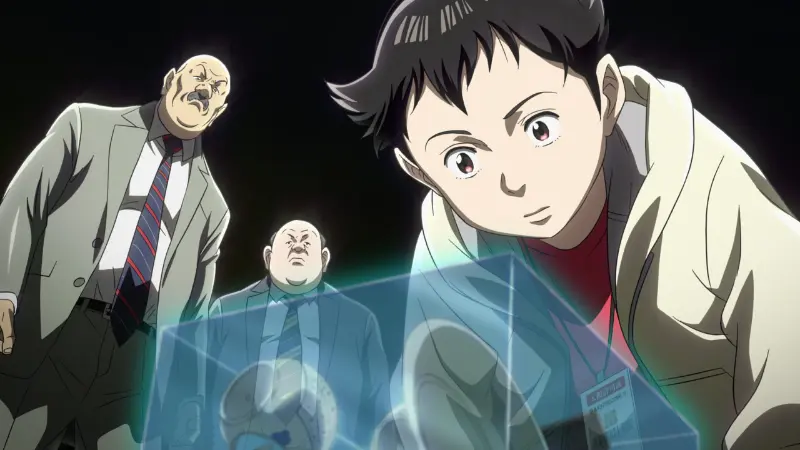
The detective work in Pluto is a slow, methodical burn. The killer leaves bizarre, horned symbols at every crime scene, and Gesicht must travel across the globe to interview the surviving advanced robots. The true brilliance of the mystery lies in its thematic depth; the narrative is heavily steeped in the aftermath of a devastating, recently concluded war. As Gesicht digs deeper into the case, he begins uncovering a massive geopolitical cover-up that forces him to question his own fragmented memories and the nature of artificial souls.
With each of the 8 episodes running roughly an hour long, the anime takes its time meticulously building tension and fully fleshing out the victims before they are inevitably targeted. The killer is an unstoppable, almost force-of-nature entity, completely terrifying in its execution. It is a profound, philosophically dense exploration of grief, hatred, and the terrifying realization that artificial intelligence is fully capable of committing the ultimate sin: murder born from pure malice.
Odd Taxi
Do not let the colorful, anthropomorphic animal designs deceive you for a single second; Odd Taxi is one of the most tightly written, flawless neo-noir mysteries in the history of anime. The protagonist, Odokawa, is an eccentric, deeply cynical 41-year-old walrus who drives a taxi through the neon-lit streets of Tokyo. He suffers from chronic insomnia and mostly keeps to himself, passing the time by listening to comedy radio broadcasts and engaging in razor-sharp, Tarantino-esque dialogue with his eccentric passengers.
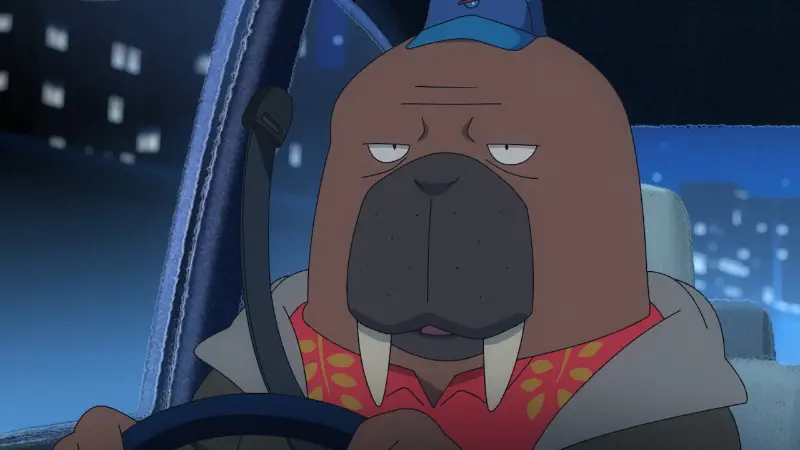
The overarching mystery ignites when a high school girl goes missing, and the police trace her last known whereabouts to Odokawa’s cab. What starts as a simple missing person case rapidly detonates into a massive, sprawling conspiracy. Every single passenger Odokawa picks up—from an aspiring idol group and a failing comedy duo to corrupt cops and a terrifying Yakuza boss—is deeply, intricately connected to the crime. Odokawa, armed with nothing but his sharp memory and deadpan wit, is forced to navigate the criminal underworld to clear his name.
The scriptwriting for Odd Taxi is genuinely peerless. There is absolutely zero wasted dialogue in the entire 13-episode run; a throwaway joke made in episode two becomes the critical piece of forensic evidence required to solve the murder in episode twelve. The slow accumulation of tension, combined with a mind-shattering final twist regarding the nature of the animal designs, cements this series as an absolute masterclass in deductive storytelling.
Monster
Sitting completely untouched at the absolute pinnacle of the detective and mystery genre is Naoki Urasawa’s magnum opus, Monster. Set in the grim, politically fractured landscape of post-Cold War Germany, the story follows Dr. Kenzo Tenma, a brilliant, highly empathetic neurosurgeon. Forced into a moral dilemma, Tenma chooses to operate on a critically injured young boy instead of the city’s mayor, completely ruining his political career. Years later, Tenma discovers that the boy he saved, Johan Liebert, has grown up to become a hyper-intelligent, charismatic, and completely untraceable serial killer.
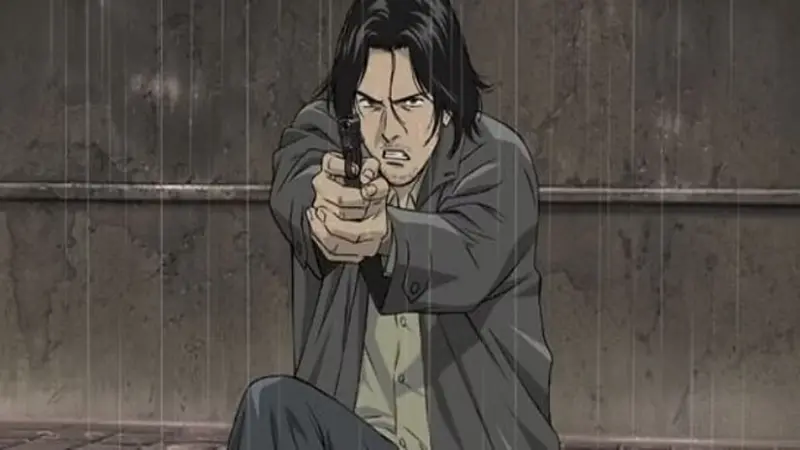
Crushed by the overwhelming guilt of unleashing a monster upon the world, Tenma abandons his medical practice, acquires a firearm, and embarks on a massive, cross-country manhunt to kill Johan. What makes Monster the definitive masterpiece of the genre is that Tenma is not a trained detective; he is a doctor. He has to learn how to track criminal syndicates, interview traumatized orphans from illegal government experiments, and survive on the run from the BKA (German federal police), who believe Tenma is the one committing Johan’s murders.
The cat-and-mouse game between Tenma and Johan is the greatest psychological thriller ever animated. Johan does not kill using supernatural powers; he completely breaks the minds of his victims, manipulating them into committing suicide or slaughtering each other simply by exploiting their deepest traumas. The 74-episode narrative is a slow, methodical, and profoundly heavy exploration of nihilism, the origin of evil, and the agonizing weight of holding a human life in your hands. It is the absolute gold standard for the detective genre.
The Final Deduction
The detective genre represents the absolute intellectual peak of anime storytelling. Whether you are holding your breath during the meticulous, historical forensic breakdowns in The Apothecary Diaries, or feeling the crushing, existential dread of tracking Johan Liebert across Europe in Monster, these narratives demand your complete, undivided attention. They prove that the most intense battles are not fought with massive explosions, but with the slow, terrifying realization of a bloody truth.
If you have successfully pieced together the clues of this list and want to dive deeper into the minds of characters who operate on a completely different cognitive level, you need to step into our Genius Protagonists Hub. Or, if the psychological weight of these serial killer manhunts has you craving even more suspense, explore the darkest corners of the medium in our breakdown of the best psychological anime ever created.
But before you close the case file, we have one final interrogation for you. Which investigative mind do you truly respect the most? Would you trust Maomao’s poison expertise, or Odokawa’s razor-sharp memory to crack the case? Head directly over to the Smash or Pass global arcade right now. Drop your votes, rate your favorite detectives, and see if your deductive reasoning ranks among the elite.
Which detective would you hire to solve your murder?
Frequently Asked Questions
Why is Detective Conan not on this list?
Is Link Click technically considered an anime?
What makes Monster the best detective anime?
Do I need to know Astro Boy lore to watch Pluto?
Is The Apothecary Diaries actually a detective show?
Rank Your Favorites
Take a break and play our interactive Smash or Pass games. Vote on your favorite anime characters, game characters, and idols to shape the global tier lists.



Join the Discussion (0)